This is my advert design, created in Photoshop. The background was added because I wanted the advert to have a grungy, urban feel - which the text also helps to develop. I edited the colours of the wolf to look like a three-dimensional image in order to disconcert the audience and to portray the feeling of nausea after getting a headache. The main title text looks a little like the text on a Wanted poster that one would see in old Western films - I wanted to create that kind of image for my advert. This also helps it to tie in with Aline's DVD cover.

 These are the sketches that I produced for use in my advert design. We agreed that we wanted a theme to be shared between the digipak and the advert, so we worked on drawing in a grungy, almost messy style to portray the indie, rock and roll image of the band and also to present a memorable image of the band's name. The images were drawn with fine-liner pens.
For example, in the video by The Horrors, which I analysed, the band members had a clear and consistent style, which connected them all together as one unit, something which is important for a band. Their dark, gothic style easily fit in with their dark, gothic music and it is also something that they will be recognised for.

With artists such as Lady Gaga, there is not a clear link between her music and the image that she has created and she often faces criticism for being too over the top and eccentric. Artists generally stick to stereotypes, as it is easier than breaking away from the conventions.
For example, a rock band would usually wear clothes that are associated with rock music, such as black, leather trousers and thick, heavy boots. They may wear eyeliner, or ‘guyliner’, as it is referred to now. A hip hop artist would generally wear a bandana or baseball cap and heavy gold jewellery, with a vest and baggy jeans or tracksuit bottoms.
The setting of the video can help establish image as well. If the artist wants to come across as wealthy, they’d film their video in a luxurious location, as is the way with a lot of R’n’B music. If artists want to associate themselves with darkness and evil, they’d film it in a dark, dirty looking location with skulls or gore and other symbolic imagery. The mise-en-scene is important in showing what the artist is trying to represent as their image.
Division of power in videos can also help reinforce the artist’s image. In a lot of rock, R’n’B and hip hop videos by male artists, women have a much lower status than the artist and the other men in the video. Hip hop artists often take the image of being a ‘pimp’ to a literal level, being dominant over the women, who are usually dressed in revealing outfits or are actually completely topless.
Women are often treated as if they were just objects – different parts of their bodies are shown separately, so the audience doesn’t see the whole woman, just parts of her body, such as her breasts.
These videos use voyeurism as a selling point and as a way to gain notoriety and popularity. It also reinforces the image that these artists build for themselves. They want to come across as tough and manly and even frightening. They want to show that they can get any woman that they want and still have others throwing themselves at them.
Even when a female artist is representing herself in a music video, her image is usually similar to the way women would dress in these videos, regardless of the genre of the music. Most female artists use their bodies as a selling point, even if they are more dominant in the video than males. They generally wear revealing outfits to show that they are attractive, to show their bodies off to those watching the video and even if they wear non-revealing clothing, they are still made to look attractive and appealing in order to sell their music.
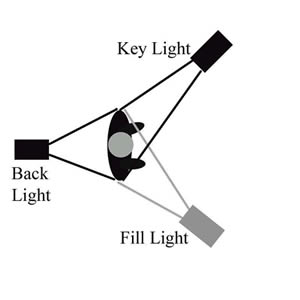
Three Point Lighting.
While filming a video, the use of three lights is important. The key is the main light and is the most important one. It is usually placed at about 45 degrees from your subject and the light is aimed down, rather than directly at the subject. As it is the main light, it is the main source of illumination on the subject and as a result may cause strong shadows.
The fill is usually set at about 45 degrees from your subject on the opposite side to the key and is broader and usually about two or three stops dimmer. The job of the fill is to keep the shadows from the key from being too strong.
The backlight is aimed at your subject from behind and above and is also set at about a 45-degree angle. It gives the subject a glow, which gives some separation between the subject and the background behind them. This is often called a "defining edge". This is particularly useful for shooting someone with dark hair against a dark background.
Light Modifiers
Using natural light.
The sunlight, when it is a sunny day, will be quite harsh, causing deep shadows on the subject. Shady areas, beneath trees, can be used to lessen the harshness of the light. Reflectors are important when shooting outside, but as they can be expensive, sunshades can also be used. Because the sunlight only falls at one specific angle, reflectors are necessary in distributing the light to other areas. Reflectors catch the light and send it in the direction you want it to go. This creates two sources of light and creates more of a studio environment outside.
Increasing light.
When in a studio or somewhere else with electrical lighting, if you find that the lighting on your subject is not strong enough, the easiest way to combat this is to simply move the light closer to your subject. Also, the location of the subject can be changed so that the light falls in the right places. When indoors and using natural light, make sure all the blinds or curtains are open so that the maximum amount of light comes in. Turn electrical lights on to maximise the amount of light in the shot and lessen the amount of noise that will show on your footage.

 Marc Webb is an American director from Indiana. He has produced music videos for rock acts, such as My Chemical Romance, Green Day and The Used, as well as popular music acts like Hilary Duff, Pussycat Dolls and P Diddy. His work is aimed at a mainstream audience, like Jonas Akerlund’s but unlike Chris Cunningham’s, and he has a large budget for production.
  Jonas Akerlund is a Swedish director, based in America and he has worked with mainstream acts such as Lady Gaga, Madonna, Metallica, U2 and Britney Spears. The video for Lady Gaga’s Paparazzi received five nominations at the VMAs and won the awards for Best Art Direction and Best Special Effects. The follow-up video, Telephone, was inspired by Kill Bill – Tarantino even let them borrow the car which Uma Thurman drives in the film – and received critical acclaim and awards for Video of the Year and Best Collaboration.
 These types of music videos often cross over into each other, so it is possible to have a performance video with a narrative sequence or a concept video with a performance sequence.
 As a general rule, the sound in a music video is non-diagetic, as the artist mimes the song and the original track is played over it. However, sometimes speech is used between characters in a music video, such as in Aphex Twin’s video for Windowlicker.

.jpg)