1. In what ways does your media product use, develop or challenge forms and conventions of real media products?
I believe that our music video for the song “Headache” by “Wolvves” uses the forms and conventions of music video seen with most indie rock genres, but challenges the connotations of real media productions. This is because of the montage sequences and multiple locations that we used in it, making it seem conceptual and more artistic, supporting our research into indie rock themes and connotations. This gave us a new creative edge that we, as a group, believed would encourage the band’s success. We avoided a narrative format because we found that to be most commonly used when making music videos, especially in pop genre songs, which our band didn’t fall under. Instead we chose to use more performance styled locations as it made the band seem less ‘labelled’ and more realistic, relating to our target audience.
We tried to use as many camera angles as we could to capture the excitement and adventurous nature of the band, ranging from long shots to extreme close ups to enhance the individuality of each member yet the bond they all have together as a band. The intensity and skill that we tried to show using extreme close ups was supported by the synchronicity of the long shots we used of everyone together, especially when members were playing instruments. Like the Avenged Sevenfold and Sum 41 videos we analysed in our second proposals we were inspired to use P.O.V. shots to show the crowds during one of the bands live gigs to show the audience that their music is enjoyed by others.
The editing methods we used for our music video were far from similar to those of real media products due to the fact that we hardly needed to use continuity editing. The amount of lip and instrument synchronicity we purposely avoided deviated the perfect timing seen within every other music video our audience would be aware of, giving us an almost dominating, artistic edge; great for the vast majority of indie rock fans. Shots were de-saturated to contrast the lighting of other parts and we increased the speed during fractions of the timeline yet had to slow others down to intensify the actions occurring. Nearly every shot will oppose with another, yet harmonizes with it at the same time. It is this contortionist style that has appealed to our audience.
2. How effective is the combination of your main product and ancillary texts?
Our main product was solely based on our subordinate texts to make sure the combination between the two was successful. We used our research to aid in the creating of our music video to make sure that it suited our target audience and genre.
Our primary research texts suggest that our bands theme of Indie Rock would connote them as a band seen different to others; wearing makeup or piercing themselves, but not to the extent of the connotations of those within the rock genre. The members within our band were styled to be “stereotyped” as normal individuals as they wore casual clothing and styled simple haircuts. However, one of the members had his ears pierced and another portrayed a slightly rugged look (with a beard), connoting a more rebellious stereotype, but not one to an extremity.
Other suggestions we researched state that the style of song and music video for an indie rock band would contain multiple attributes of an artistic style yet would not breach into the form of a piece of conceptual material, as some find this style to be confusing and more suitable for a more foreign or techno genre. Most points we learnt about the Indie Rock genre were opinions and preferences showing us how broad the spectrum for this particular style is. We originally understood from our interviews that very controversial videos will be disliked by many but will gain the most publicity, just like the current debates with the ideology of Indie Rock.
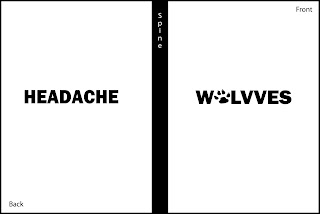
Through the learning and understanding of the Indie Rock genre we were able to create our advertisement and Digipak Cover/Insert. Reflecting the edgy, artistic persona of our chosen genre we each came up with designs that were self explanatory for the band - Wolvves. We chose to use traditional media methods when creating the initial images which we then scanned and used Photoshop to further manipulate. We thought that not using a photograph or Clip Art would make our products stand out against real media products.
However we did try to create a very simple yet bold digital at first that used the contrasting tones of Black and White. We figured that this cover would provoke curiosity within our audience but as our band are only starting, we realised that we should be promoting them as much as we could at this stage and show their creativity to excite new audiences.
I believe that our music video for the song “Headache” by “Wolvves” uses the forms and conventions of music video seen with most indie
 rock genres, but challenges the connotations of real media productions. This is because of the montage sequences and multiple locations that we used in it, making it seem conceptual and more artistic, supporting our research into indie rock themes and connotations. This gave us a new creative edge that we, as a group, believed would encourage the band’s success. We avoided a narrative format because we found that to be most commonly used when making music videos, especially in pop genre songs, which our band didn’t fall under. Instead we chose to use more performance styled locations as it made the band seem less ‘labelled’ and more realistic, relating to our target audience.
We tried to use as many camera angles as we could to capture the excitement and adventurous nature of the band, ranging from long shots to extreme close ups to enhance the individuality of each member yet the bond they all have together as a band. The intensity and
 skill that we tried to show using extreme close ups was supported by the synchronicity of the long shots we used of everyone together, especially when members were playing instruments. Like the Avenged Sevenfold and Sum 41 videos we analysed in our second proposals we were inspired to use P.O.V. shots to show the crowds during one of the bands live gigs to show the audience that their music is enjoyed by others.
The editing methods we used for our music video were far from similar to those of real media products due to the fact that we hardly needed to use continuity editing. The amount of lip and instrument synchronicity we purposely avoided deviated the perfect timing seen within every other music video our audience would be aware of, giving us an almost dominating, artistic edge; great for the vast majority of indie rock fans. Shots were de-saturated to contrast the lighting of other parts and we increased the speed during fractions of the timeline yet had to slow others down to intensify the actions occurring. Nearly every shot will oppose with another, yet harmonizes with it at the same time. It is this contortionist style that has appealed to our audience.
2. How effective is the combination of your main product and ancillary texts?
Our main product was solely based on our subordinate texts to make sure the combination between the two was successful. We used our research to aid in the creating of our music video to make sure that it suited our target audience and genre.
Our primary research texts suggest that our bands theme of Indie Rock would connote them as a band seen different to others; wearing makeup or piercing themselves, but not to the extent of the connotations of those within the rock genre. The members within our band were styled to be “stereotyped” as normal individuals as they wore casual clothing and styled simple haircuts. However, one of the members had his ears pierced and another portrayed a slightly rugged look (with a beard), connoting a more rebellious stereotype, but not one to an extremity.
Other suggestions we researched state that the style of song and music video for an indie rock band would contain multiple attributes of an artistic style yet would not breach into the form of a piece of conceptual material, as some find this style to be confusing and more suitable for a more foreign or techno genre. Most points we learnt about the Indie Rock genre were opinions and preferences showing us how broad the spectrum for this particular style is. We originally understood from our interviews that very controversial videos will be disliked by many but will gain the most publicity, just like the current debates with the ideology of Indie Rock.
Through the learning and understanding of the Indie Rock genre we were able to create our advertisement and Digipak Cover/Insert. Reflecting the edgy, artistic persona of our chosen genre we each came up with designs that were self explanatory for the band - Wolvves. We chose to use traditional media methods when creating the initial images which we then scanned and used Photoshop to further manipulate. We thought that not using a photograph or Clip Art would make our products stand out against real media products.
However we did try to create a very simple yet bold digital at first that used the contrasting tones of Black and White. We figured that this cover would provoke curiosity within our audience but as our band are only starting, we realised that we should be promoting them as much as we could at this stage and show their creativity to excite new audiences.
 Our video analyses led us to become inspired greatly when creating our main product. The text we used to explain the detail of each video helped us visualise our own ideas and grow an understanding of what lighting, camera shots, editing techniques, etc, would give our products more promotional success. For example, we were inspired by the diary-like format seen in Sum 41's music video, as well as the P.O.V shots looking onto the crowd that we later on used ourselves.
3. What have you learned from your audience feedback?
From our audience feedback I have learnt that a music video can help promote a band e.g. via YouTube, Facebook, etc, but people may not be encouraged to realise the effort behind the video if they don’t enjoy the song, making it i
 mportant for us to advertise to our target audience. However, our initial research rebuts this view, as it’s through the music video that some songs and bands/musicians become discovered.
The quality and technology used shows the audience an approximate budg
 et, allowing them to be more critical or more sympathetic with their judgement, depending on the person. As we filmed using a Canon XM2 the quality of our video enhanced the quality of our band.
Setting/scenery is more important than I initially thought. Some people enjoyed the shots tha
 t were filmed outside because it made the band seem more open and sociable, helping me understand that a location can input certain connotations onto the band.
Effects put onto shots can sway audience appreciation of the music video too. The shots we turned into monochrome made the music video look more artistic, supporting our research into Indie Rock music ideologies, much to the
 pleasure of some. Yet the colourful lighting of other shots took a selection of others’ interest because they liked how playful and creative a shot could appear, just by adding in some colour.
 I believe most of our feedback was positive and has given me the reassurance that our concept/performance style of music video, involving multiple scenes, lighting and shots, appeals to a greater audience than that stereotypically involved with the genre we originally tried to appeal to. Supporting the forms and conventions of our chosen genre (Indie Rock) whilst challenging the forms and conventions of real media products made our music video unique and created a lot of debate, making the song gain publicity.
4. How did you use new media technologies in the research, planning, construction and evaluation stages?
New media technologies involve better quality cameras and computer software, the use of internet and better sources of research, giving us greater opportunities to promote our music video.
For our research stages I used search engine, via the internet, Google as I knew it would supply me with reliable secondary research. I used Wikipedia when gathering specified and detailed information, nonetheless I made sure that I had my own understanding of the data I researched.
I handed out questionnaires, containing quantitative questions, for the reason that this is the most trustworthy source of information. Quantitative questions gave me easy to analyze, statistically reliable results to, which I used when comparing results with certain age groups or stereo types.
I needed a solid foundation of research so chose to interview a selection of people as well, using qualitative questioning through face to face involvement, as I could note the opinion, attitude and behavior pattern of the individual I was questioning.
When filming our music video we used a Canon XM2 camera which established high quality videos and greater definition when concentrating on certain objects. The audio level indicator was used to distinguish shots from interior locations to exterior. The exposure dial and white balance meter helped us obtain the correct lighting as the harsh natural sunlight differed from the dark and dimly lit pubs at night. As a result of using extreme close ups we used the zoom controller that permitted us to flow between different camera shots and angles whilst filming. Auto focus was used when filming, even though the non-square box position/mode is not suitable for all kinds of lighting, because the fast paced, quick changing shots that were used to accompany the bands characteristic were difficult to manage along with manual focusing. We tried to use as many angles, scenes, movements and camera shots as possible to gain some form of audience’s interest to promote the band Wolvves. During our research we learned that controversy can still be perceived as publicity.
When editing our music video we used Final Cut Pro on a Mac. This program enabled us to log our tape and timeline and capture it to the computer’s internal hard drive. We used the razor tool to cut a preferred shot down to the millisecond, allowing, in our case, perfect discontinuity in addition to giving us the ability to add in effects after filming.
To establish each location we added an after effect to some of them. The inside shots were de-saturated to monochrome, dominating black and white, whilst we increased the vibrancy of the live performances inside to enhance the lighting. Furthermore, I believe we should have used sepia tones for the fast paced, outside, establishing shots as it would have aided the audiences understanding to the use of monochrome shots.
We used jump cut transitions to demonstrate the active personalities of the band as well as display the meaning behind the song, which we later found out from our audience feedback was a successful trait.
To obtain the best possible audio quality we used an mp3 file as opposed to the live recordings that accompanied our performance shots. We had to synchronize the mp3 song file to the video file using the preview viewer box to visually match our shots to the lyrics and used layers to separate the files and match them to our logged timeline. Our completed video needed to be formatted to suit our chosen output (YouTube, DVD, TV, etc) yet compressed if we wished to transfer the video file via USB. We changed the resolution and file format to suit the multiple media formats used today (Quicktime, Windows Media Player, VLC, etc) and took the risk of using more gigabyte space to save a video of greater quality.
When creating our adverts and Digipak Cover/Insert we scanned our traditional media drawings in and manipulated them using Photoshop. This software allowed us to manipulate images together, putting each image into a specific layer and overlapping it with the others to create new and different designs. When creating the Digipak insert I was capable of copying the original JPEG file of the background spiral design to place above and behind the wolf drawings I had created.
I was similarly able to put text and writing over the top of images or around them, in any font and colour to suit what I thought would be necessary to compliment the other designs we agreed on.
I selected a faux brush and lowered the opacity to create the textured background that appears with both light and dark tones of grey whilst I used the Brightness/Contrast adjustment to make the outline of my wolf drawings bolder to stand out against the font.
Access to the internet allowed me to promote our video globally using video websites (e.g. YouTube), blogging websites (e.g. Blogger) and social network sites (e.g. Facebook) by uploading it, allowing public viewing and allowed audiences to freely comment their views and concerns about the music video and spread it to others themselves, promoting the band.
When updating our blog with certain documents, I used the websites Slideshare for .doc files and Slide for multiple .jpg files to create show reels that allowed neat presentation and easy browsing for my audience. I uploaded photos and screen shots from our actual music video to analyse and support, using primary sources, specific statements or opinions from myself or my audience feedback.

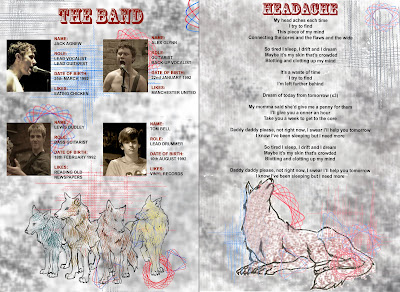 This is my final design for the Digipak Insert that includes information on the band the title and lyrics to the bands main featured song: "Headache". The band information allows the audience to briefly understand each member with the music video feeding them additional information that the insert doesn't give them. A photograph of each member 'in action' promotes the professional ambition that they posess yet a small hint of their interests have been mentioned within their "Likes" section. I contacted each member of the band personally to obtain each element of information I needed as I know primary research is the most reliable. I inserted the image I drew of four wolves to mimic each member of the band and relate them to their name. Each wolf has been shaded and textured using a different colour to make each one unique and I used the spirals and lines as additional background features to match the digipak cover and advert the others have made with the same grey pattern to mould everything together.
 This image was an initial idea for a simple logo; something with the ability to modify and manipulate text around i.e. the name of the band. However, we all agreed that this image didn’t represent the band properly and a more clearer image of a wolf should be drawn to create a more attractive image for the audience to be drawn to.
  This image was created to depict a clearer image of a wolf. I trued to make position the wolf into something unique and something that makes the product seem more humorous. But the image was determined too complicated to be placed with text and not original enough to stand out.

 I created this image to try and portray the band through their name. There are four members of the band, so I drew four wolves. Each wolf is different (although more difficult to see in a black and white image), reflecting the uniqueness of each member, yet when all put together they create a harmony; a whole. We agreed that this image could possible be successful, but only for other merchandise possibilities, not for the actual digipak colver or magazine advertisement.

 The last two wolves I drew were designed to fit what we wanted as a group. The realism of each wolf creates a dynamic impact on audiences and makes it clear what the image is trying to represent. I chose to do both wolves completely different so it was possible for us to use either one (or both) depending on what we wanted.